Showing posts with label Feminism. Show all posts

Friday, 11 April 2014

The nun fled to the cloistered mysteries and reborn in the unified Italy


Monza's nun, Giuseppe Molteni, 1847, Museum of Pavia.

Henrietta Caracciolo was born on February 17 th in 1821. Her life was an extraordinary life that seems to be a novel, one of those written by some her contemporary to denounce and exemplify the status of women but, on the other hand, does not take a cue from an emblematic example but from her life, her biography, a life story lived on the skin, like that of many heroines, and this word was never more fitting if not for her.

She born in Naples by Don Fabio Caracciolo, son of the Prince of Forino, Marshal of the Neapolitan army, and by the noblewoman Teresa Cutelli, in one of the "first and most substantial families of Naples" [1]. She lived a fairly quiet existence between Bari , Naples and Reggio Calabria, apart from a break of a few years when her father loss his job. When her beloved father dies of infection to internal organs, her mother wishes to remarry, so started the procedure to let Henrietta to get in the convent, without she was aware of it. It implements what a "forced" nun a few centuries before, the Tarabotti, identifies as the greatest betrayal, that of ones parents.

Henrietta seeks shelter from the maternal decision and despairing and crying she obtened from her mother the promise that she will stay in the convent only a few months and then could come back to home.
So Henrietta finds himself bound and, as in the "best" tradition, was collocated in a convent where were already present her paternal aunts, at the Convent of San Gregorio Armeno in Naples, following the Benedictine tradition, because: "(...) they gave me the name of Henrietta , name of a nun paternal aunt: one of the innumerable offerings to the order of St. Benedict, in which my ancestry was consecrated ". [2]
Henrietta undergoes what the society had as an ordinary habit worn on the skin of women, in fact her older sisters were married but she, with two love gone wrong and no dowry after the death of her father, will be the only one to be, the fifth of seven daughters, a forced nun, even the malformed Josephine, now lame after a disastrous fall, will get married.

Henrietta is the victim of a practice that in theory was already condemned by the Counter-Reformation of the sixteenth century but that in the practice had not actually had any effect on the much more established habits in use in the culture of the society of pre-Italic demonstrating a unified habit of costume even before the unified process of Italy as a nation.

Henrietta,  at least initially,  left the convent, determined not to take the vows inspite of the insistence of all the other nuns and of the abbess, her aunt, of the prelates and the confessors, and took refuge in the home of a brother in law where, however, she learns from her older sisters, who got married in Reggio, that their mother is about to remarry in Reggio and wants to take her there  to join a convent in Calabria, and moreover that her boyfriend courting another girl .  So Henrietta at this point,  is alone, without support and without a place to go, achieved by the gendarmes who accuse her of insubordination to the will of her mother, to follow them to the embarkation point for Reggio, then she is forced to return to the convent and take vows: "My sacrifice was consumed by that time: I saw myself as a victim". [3]

So in 1841, Henriette takes her final vows and finds herself unwillingly nun but if "I had made to the community the sacrifice of my person not already one of my reason, which is an inalienable right" [4] now "dead is the past, extinct the future for me, and memories are just a vain dream, and hopes a crime "[5]" it was supposed for me not to have  a mother, neither sisters, no relatives, no friends, no whatsoever substance; I had abdicated even my personality"[6].
 
Monza's nun, Mosé Bianchi, 1867, Museum of Monza.

The first impact in the convent was of the worst, she educated and lover of the arts and literature, finding herself to live in claustration, with rough, uncultivated, semi-illiterate nuns: "most of them are young, or at least not old, and all, as I said, belonging to the most significant, if not always the richest, families of the former capital.
But I had the opportunity to observe, since the first day I entered the convent, that the intellectual and moral point of those nuns did not respond to the loftiness of 'their birth ". [7]


Her existence, we said it, seems like a novel, and so even Henriette, like any self-respecting heroine, had her bad: the archbishop of Naples, Riario Sforza, to which she devotes an entire chapter, the seventeenth, of her Memoirs.

With the election of Pope Pius IX, Henrietta thought to have a glimmer of hope in solving her condition, asking for clemency directly to the Pope who  did not seem  contrary to her demands except that the archbishop of Naples, Riario Sforza would not release the authorization that would allow Henrietta to start a new life, even in contravention of papal preferences.

During the riots of '48, for the independence of Italy, Enricchetta takes courage and start to read, even in a loud voice in the convent,  "revolutionary" newspapers, careless of the fame that is given to her of being involved in secret societies and a  revolutionary.
She appeals once again to the Pope for her freedom, informing him that otherwise she would have taken advantage of the freedom of the press to publicize her condition of forced nun. So the Pope gave her the authorization to go to a conservatory, of Constantinople, but the archbishop Sforza, becoming aware of his defeat,  forces her to leave at the convent her family assets, and the precious silverware.


At the Conservatory of Constantinople,  the nun found an environment that isn’t open and conciliatory, and in which she had to abandon all hope of being able to cultivate her readings and so she had to concentrate herself exclusively on the biographies of the saints and martyrs of the Church, discovering how the female figures had contributed, revealing those fundamental but also the lack of an official acknowledgment by the Church about this importance.

Enrichetta Caracciolo as in the cover of Her "Memories"

Meanwhile, the archbishop Sforza continuing his fight against Henrietta and he succeed to intercept some of her writings that she was able to put them out of the Conservatory with the complacency of a housekeeper. These writings were brought to the Pope to convince him not to give in to the rending  demands  of Henrietta and of her mother, who divorced in the meanwhile by her second husband and now was repentant of the injustice suffered by Enrichetta.

Only in 1849 Henrietta finally was able to get out of the conservatory to be treated to the nerves,  with her mother, but the permission for the following year  was denied by the archbishop, Vicar of Naples, Riario Sforza.

At this point, the mother of Henrietta, Teresa, applied herself to "save" her daughter making her escape and take her refuge in Capua under the protection of its bishop who however died only a few days later but with the help of a friend, a priest too, Henriette had the allowed to go and live with her mother, just following the rule of the Canonichesse of St. Anne. She was even managed to take back the income of her monk dowry who had seized by Riario Sforza, making her live exclusively thanks to her parental help and support.


In 1851, the archbishop, strong of his influence on Ferdinand II,  arrested Harietta and led her to the Church of Saint Mary full of Grace in Mondragone where Henrietta attempted suicide, first by refusing food, and then stabbing herself in the chest. Because of her weakness due to the lack of nutrition, however, her injury was not enough to take her to death, and so she survived for an entire year resisting the seclusion, but when she was even prevented  to go to the bedside of her dying mother, aided by relatives and aunts, she turned once again to the Curia for help. She appealed in fact to the Sacred Congregation for to have a permission to go to Castellammare Bath for health care. This time she went through it, in fact, now even the Curia was annoyed by the persecution, to this point clearly  personal, of the Riario against Caracciolo and it was able to find a basic misunderstanding in the archbishop’s letter to consent Henrietta to treatment herself.

From here Henrietta found a new life: "On November 4, 1854, after three years and four months in cruel captivity, I saw the light of the day". [8]

In the meanwhile she was back to Naples in disguise, to help the willing of the unifying  Italy: "What did I do in Castellammare in the while? [...] Thinking, then, that you would found a little place for my contribution in Naples, I thought of disregarding of all danger for me, as I could offer my services to the movement which need them "[9 ].
She hidden herself, changing home and service staff as you change the tablecloth to escape the spies of the Bourbons and of her historic enemy  who was waiting  his revenge, the archbishop Sforza.
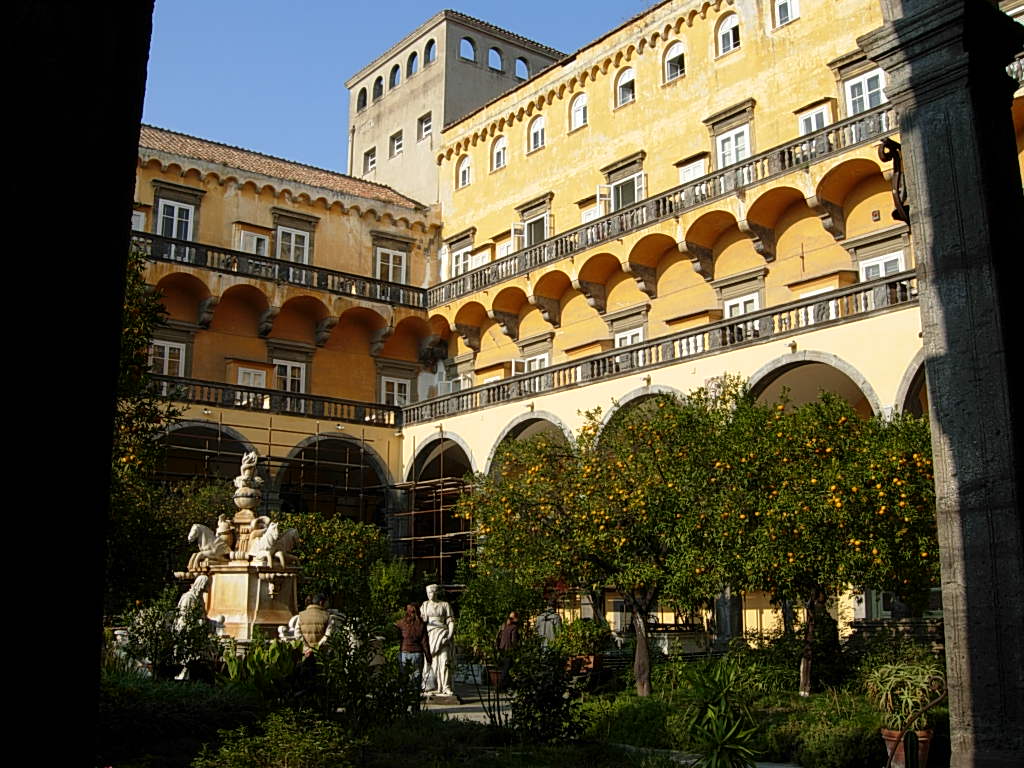
The Cloister of San Gregorio Armeno's Church in Naples.

By now she was really in touch with the Liberals and with the fathers of united Italy. So in 1860, during the Te Deum  to celebrate the escape of King Francis II of the Two Sicilies, in the presence of Garibaldi "[...] I left the black veil from the head, and put it on an altar, I made a note of restitution to the Church, which had given me it twenty years ago. VOTUM FECI, GRATIAM ACCEPI "[10] (I took votes, and now  I take my mercy) .

Thus began a new life for Henrietta, her true life, but no less adventurous and fascinating.
She married John Greuther, choosing the Protestant rite after the denial of the Catholic Church, and she begins to tell, thanks to the press, her extraordinary existence scratched by the monastic vows.
In 1864 it will be the turn of her first opera, her memoirs that were translated in six languages
​​: English, French, German, Spanish, Hungarian and Greek and had a resounding success even in Italy with no less than eight reprints, which also earned her the praises of Manzoni and Garibaldi.
Two years later, in 1866, It is her second book "A crime unpunished: the historical fact of 1838" in which she recounts the murder of a schoolgirl by the priest who the girl had  rejected.

She wrote over the years: "Miracles" in 1874, a collection of poems against superstition, and the drama "The Strength of Honor," which was also represented in theatres. In 1883, a drama in five acts "A episode of Mysteries of the Neapolitan Cloister ", based on her memoirs, was published. She wrote also numerous articles as  correspondent for the newspaper " La tribune" of Salerno," the journal of Naples "and" the Nomad" of  Palermo.

She was a prominent member of several associations including the “Banner of the Charity”, the “Association of the youth studious of Naples”, the “Society for the Emancipation of Women” of  Lorino,  so that in 1866 on the occasion of the motions of the Third War of the Italian Independence she appealed directly to women, by publishing the "Proclamation to the Italian Woman" for mobilizing women to the national cause.

Her support to the Italian politic will be always broad and unconditional, supporting, through the Committee of the Neapolitan female, with her sister Giulia Cigola, the bill of Salvatore Morelli, in 1867 "For the legal reintegration of women" in which he asked participation in the political and administrative vote for women, a bill which, however, was not even allowed to read.

Unfortunately, , despite Henrietta had mobilized and dedicated herself to the cause of Italy, she didn’t receive  recognitions, in fact, Garibaldi left Naples to go to Capri, before signing a decree by which he wanted  to appoint Henrietta inspector of schools of Naples and the same did  the Minister of the education, De Sanctis, who even if  had promised her a job, then disowned her. So as usual  the history of women,  unluckily as we  know, is another thing from the History.

So Henrietta lived the last years of her life in her hometown, now a widow and without her family's assets that the archbishop Sforza had kidnapped and that was never found, forgotten by her people but at least finally free. But we love remember her, like she would: "[...] And the name of Citizen, which gave to everyone does not contain any distinction, it became to me the right and only title [...]. [...] Citizen so call me, and if you want to add a distinction just say that citizen who provoked and promoted the Plebiscito of women in Naples "[11].
And in Naples, in her city, she died in March on 17th, in 1901, aged 80.


Mysteries of the Neapolitan Cloister: Italian version, as the original.


Friday, 7 March 2008

Not only Mimosa


For the women's day is coming out on cinemas a documentary by Alina Marazzi about the italian 60's and 70's feminist mouvement..

In Italy each day we hear about violence, frustration of women, every day one can find such a thing on newspapers or in tv. The violence against women is really spread out in Italy and becoming worrying day by day, in 2005 a murder every 4 happens at home, 70% of murdered are women. This movie is about our history because everyday life recalls us how difficult is to be a woman, as the director says: "In Italy, also on the street, one can't forget, even for a while, that you are a woman before be a person". In this documentary one can see the fight of that period for issues even nowadays on the italian agenda, we can see how the italian feminist mouvement has succeeded for all us but also how much is again to do.
"We want roses too" title due to the american workers of the XX century who stroke for bread but also for roses meaning a better quality of lifestyle for women and as the director says: "Maybe feminism has no urgency nowadays but there is again a lots of things to do, it happened a change in social costumes that we assume...maybe the necessary, the bread, is acquired but women fought also for a world in which there would be space for the poetry of roses and this is a current battle more than ever."


Wednesday, 5 March 2008

Tina Lagostena Bassi the lawyer of women

On 4th March is dead, after a long illness, Augusta (Tina) Lagostena Bassi, a great woman of law who had always fought for italian women's rights; she was born in Milan on 2th March 1926.
She started her career as a professor of penal Law at the University of Genoa, then moved to the University of Parma.
From 1973 to 1975 she worked for Reformation Bureau of the Italian Justice Minister and represented Italy at Praga's 1983 World Peace Meeting.
She started to defend women from stalking and sexual violence and first in Italy during her work has used cruel words, during processes, to describe violence trying to shocking the italian society from the late 70's which always was reticent to women violence, to breaking silence among this stuff.
She took the defence of the survivor Donatella Colasanti, from the Massacre of Circeo (1975) where three guys invited two adolescents girls, known only same days before in a pub, to a party in ones of thier house at Circeo, near Rome. But no party was there, the two girls were tortured, violented and massacred for one day and one night. One of the slavedriver during the fact came back to Rome for not miss his family lunch, then came back to Circeo to continue the massacre: the two girls were druged, beaten and then, belived dead, putted in the three boys' car who went to Rome in a pub to drink something, but only one girl survived and from the luggage of the car could complain and so some citizens could call the police.

During the process, that shocked Italy for his violence due not only to misogen but also to social racism, the two girls in fact were from a media social class instead of the three boys who were from an aristocratic social class, Tina Lagostena could be able to defend the survivor girl Donatella saying she represented all women and Justice would be necesary not for revenge but for Justice itself.
She broke the cliché of women who cause the violence and that one which represent good girls staying at house, so bad girls are those who just want fun and friendship, for the first time she used the word "rape" in an italian Court.
At the end of the process she could reach to have a sentence of condemnation which transform italian value refered to women, thanks to her and her new woman style of making lawyer in a men's place as a Court.

With other women, engaged for women's rights, based, on 1988, the Pink Phone (Telefono Rosa) an association which gives free services to women in difficulty as legal support or psychological services or medical visits, this association remains the most important association in Italy for violented women also nowadays.

She has been the President of the National Gender Opportunities Commission of the Consiglio dei Ministri (the institution which coordinates the italian government) and member of the UE Gender Commission.

She was the italian Chief of the delegation at the Pechino's UN Conference for women's rights, on 1994.

She wrote also the important italian law for the sexual violence against women of the 1996 which for the first time established the civil principle that sexual abuse is a crime against a person and no more against public moral as first 1996 again in Italy was.

In 2003 she was one of the promoter for the change of the italian constitutional article number 51 which now establishes the equality for men and women in society with equal opportunities for both sex in public and private market.

From her book named "The lawyer of women" , on 1997, the public italian television made a tv-movie with the same title and starring by the most important italian actress.


In this video we see Tina during a process, of the '70s, defending a girl named Fiorella raped by four men, she knew, and who were told guilty by the Italian law even if in a derisory way!.

Tuesday, 5 February 2008

Today you can change the world...so don't miss history


Dear Friend,

I need your help today. Twenty-two states are voting in the Democratic presidential primary. I went to vote this morning in New York, and I need all of you who can vote today to go to the polls as well. You can find information on voting locations at www.hillaryclinton.com. Make your voice heard today -- vote and be counted. Be sure to tell your family, friends, and neighbors to get out and vote!

Thank you for your help,

Hillary

Tuesday, 29 January 2008

Attention all Woman

WASHINGTON (CNN)
Massachusetts Sen. Ted Kennedy is under heavy fire from a state chapter of the National Organization for Women for his decision to back Barack Obama over Hillary Clinton.In a sharply critical statement, the New York state chapter of NOW took aim at Kennedy Monday for what it called an "ultimate betrayal," and suggested the Massachusetts Democrat "can't or won't" handle the idea of Clinton becoming President of the United States."Sen. Kennedy’s endorsement of Hillary Clinton’s opponent in the Democratic presidential primary campaign has really hit women hard," said the statement. "Women have forgiven Kennedy, stuck up for him, stood by him, hushed the fact that he was late in his support of Title IX, the ERA, the Family Leave and Medical Act to name a few.""And now the greatest betrayal! We are repaid with his abandonment!" the statement continues. "He’s picked the new guy over us. He’s joined the list of progressive white men who can’t or won’t handle the prospect of a woman president who is Hillary Clinton."After months on the sidelines, Kennedy formally endorsed Obama Monday during a speech at American University, despite reported pleas from the Clinton campaign that he remain neutral. He hailed the Illinois senator for his potential to be a “president who appeals to the hopes of those who still believe in the American dream."Kennedy also praised Clinton and John Edwards in his speech, saying that “whoever is our nominee will have my enthusiastic support."But the NOW state chapter suggested Monday Kennedy's decision was a larger representation of society’s ongoing disrespect for women's rights."This latest move by Kennedy is so telling about the status of and respect for women’s rights, women’s voices, women’s equality, women’s authority and our ability – indeed, our obligation — to promote and earn and deserve and elect, unabashedly, a president that is the first woman after centuries of men who ‘know what’s best for us.’”Meanwhile, the national chapter of NOW sought to distance itself from the state chapter’s comments, issuing a statement Monday evening that praised Kennedy's record with respect to women's rights."Though the National Organization for Women Political Action Committee has proudly endorsed Sen. Hillary Clinton for president, we respect Sen. Kennedy's endorsement," NOW President Kim Gandy said. "We continue to encourage women everywhere to express their opinions and exercise their right to vote."Kennedy's office has not returned CNN's request for comment.

SPREAD THE WORD--WOMEN FOR HILLARY--YOU CAN MAKE HISTORY!!!

To the extent the media is all but ignoring the fact that millions of Florida Democrats are casting ballots today as well as the GOP, the DNC has failed us all by allowing once again the spotlight to be on the Republicans NOT the Democrats. Michigan of course faced the same fate just last week. Senator Clinton took 57% of Michigan's Democratic vote. Did you hear of that "Land slide" victory? NO. The media once again has been unfair to the Clinton campaign. Having said that, if you live in Florida, PLEASE VOTE TODAY!!!
SPREAD THE WORD--WOMEN FOR HILLARY--YOU CAN MAKE HISTORY!!!

Monday, 28 January 2008

Last but not least...

The law 493/99 rules domestic work with an assurance for all Housewives whom work is recognized by article 6 of the Chapter III: " Lo Stato riconosce e tutela il lavoro svolto in ambito domestico, affermandone il valore sociale ed economico connesso agli indiscutibili vantaggi che da tale attività trae l'intera collettività. A tale fine, il presente capo introduce misure finalizzate alla tutela dal rischio infortunistico per invalidità permanente derivante dal lavoro svolto in ambito domestico" ; "the italian state recognize and protect domestic work, saying it is of a high social and economic value for the entire society. Therefore with this law is introduced an obbligatory assurance for all housewives [...]".
But it is of today the news, but we italian women known this well, that the labour market is not easy, we are on the 29 place in the european women in labour ranking, this is the considerations of the Director of the Censis (Centro Studi Investimenti Sociali- Italian Investment Research Center) who proposes some recipes as more services to families as Kindergartens or assistance to old people, but not to women only!, more collaboration in families between men and women and to do so no economic reliefs to families because it will be detriment for women who will be not stimulate to work.
Good words I say but the reality is that just few days ago I couldn't get a work because I'm a women and I may stay pregnant, It's a reality that in factories don't exist kindergardens, that a woman have to work twice from morning to night and It's good to increase the collaboration between men and women but it's not increasing the age for the pension as the same level of men that we create equality; I think that improvements must be done thinking to the differences and recognizing them not amalgamating all always under a male point of view.
And, last but not least, I want to remind to this guy who afferm: "Finchè questo non avverrà l'Italia rimarrà un paese da terzo mondo"; "Untill this (all the points viewed upon) will be not create Italy will rest as an african state", taht in Africa there are more women in parlament than in our democratic and healthy (?) Italy.

Thursday, 10 January 2008

Gabriela Mistral


Today, in 1957, died in New York a great poet, first latin american woman to win the Nobel Prize for Litterature in 1945, she was Gabriela Mistral, born Lucila de María del Perpetuo Socorro Godoy Alcayaga in Vicuña, Chile, in 1889.

Her works show a very intimate themes of sorrow, maternity, death and love, themes that she knew trough her life when her first love lost life, when her beloved mother died, when her nephew also had suicide. She had a great life in satisfactions but also in misfortunes.
In her life she was a teacher and in her job among her students had, as a pupil, Pablo Neruda who encouraged to write.

She is known to be a poet, a teacher and a feminist, here is a little poem from Tala (Destruction) , her first book dedicated to her mother died in the meanwhile she wrote this work and from Desolaciòn.


TODAS íBAMOS A SER REINAS


"En la tierra seremos reinas,
y de verídico reinar, y siendo grandes nuestros
reinos, llegaremeos todas al mar
."

from "Tala";


LA MUJER ESTERIL

La mujer que no mece un hijo en el regazo,(cuyo calor y aroma alcance a sus entrañas),tiene una laxitud de mundo entre los brazos;todo su corazón congoja inmensa baña.

El lirio le recuerda unas sienes de infante;el Angelus le pide otra boca con ruego;e interroga la fuente de seno de diamantepor qué su labio quiebra el cristal en sosiego.

Y al contemplar sus ojos se acuerda de la azada;piensa que en los de un hijo no mirará extasiada,al vaciarse sus ojos, los follajes de octubre.

Con doble temblor oye el viento en los cipreses.¡Y una mendiga grávida, cuyo seno florececual la parva de enero, de vergüenza la cubre!


from "Desolación" .


Friday, 28 December 2007

GOODBYE...


Goodbye Benazir Bhutto a lovely,
thankful thinking to you...

Friday, 14 December 2007

800-911753

A terrible family event happened next summer in Italy: a young pakistan girl named Hina was killed by her beloved: her father, her oncle and her brother in law. She was 21 years old and her fault was that one not to be a good Muslim; she wanted to dress in a western way, to marry an italian boy, she was too european, so her relatives thought to give her a lesson. All her family, her mother too, had planned the entire affair: while her mother with the other children were in Pakistan, the males of the family would have done giustice, so Hina was killed and buried in the garden, like everyone of us could do with one of our beloved pet.
For the first time in Italy, politics, pubblic opinion, and the society all, have realized that a problem with the immigrants was there. After some months later in which in Italy seamed to be only this issue in "agenda", nothing came new even after one year.
An answer to this terrible fact come now by a private association called ACMID (Moroccan women association) which has enable a free number for all arabic women in Italy victim of violence; this center answer in Arabic, Moroccan, French and English, and it is sponsorized by the Nando Peretti Foundation, a private foundation that support this iniziative called "No more alone", because it was not possible to find a public financing.
After Hina's murder one would hope a change in the immigration policies while untill nowadays nothing was made by istitutions, so the issue can be faced only by private, women again have to take care to other women, that's because, maybe our politics are too busy in other issues like scandals with transsexuals or prostitutes, having at home a sweet pregnant wife waiting for he, like every good wife should do.
All this make me think about a Geermain Greer's sentence: "We have no other choice but to turn and fight".
800-911753